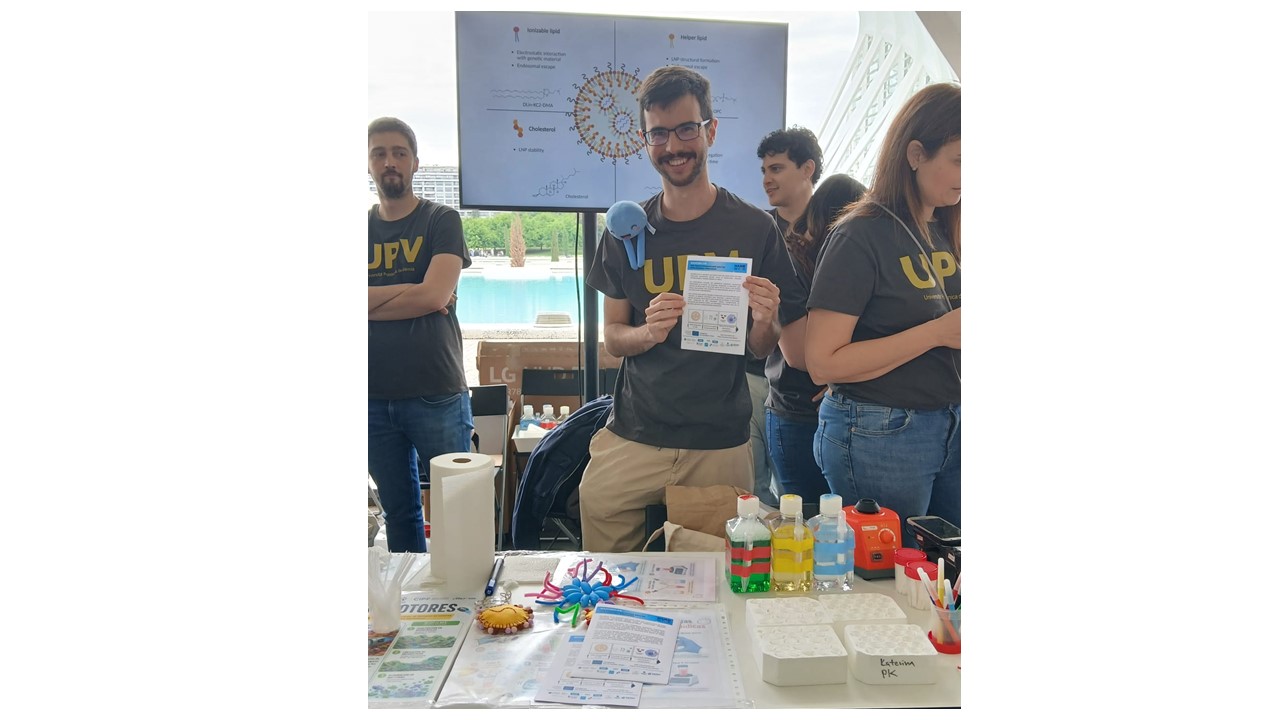
The UPV team involved in NanoBiCar shared with students, families and the general public how lipid nanoparticles are formed and how this technology is being explored in the project to develop a new immunotherapy approach against tuberculosis.
On 8 May 2026, the Universitat Politècnica de València team participating in NanoBiCar took part in the Fira dels Invents UPV, a science outreach event designed to bring research, technology and innovation closer to society through interactive demonstrations and hands-on activities.
During the event, the UPV team introduced attendees to the fascinating world of lipid nanoparticles, explaining in a simple and visual way how phospholipids and other lipid-based components can self-organise in water to form structures such as micelles, liposomes and lipid nanoparticles.
Through an educational and accessible activity, participants were invited to recreate, in a simplified format, some of the basic principles behind lipid nanoparticle formation. Using water, oil and surfactant, and applying manual mixing and vortexing, attendees could observe how lipid-based structures can emerge from the interaction of different components. The activity was supported by visual materials, explanatory posters and microscopy images, helping visitors understand how very small structures can play a major role in biomedical innovation.
The activity also offered an opportunity to present the NanoBiCar project to the public. The team explained that NanoBiCar is working on a new generation of immunotherapeutic strategies to fight resistant bacterial infections, using tuberculosis as a proof of concept. In this context, lipid nanoparticles are a key enabling technology, as they can be used to deliver mRNA-based platforms designed to support innovative immune-based approaches against both intracellular and extracellular bacteria.
By participating in the Fira dels Invents, NanoBiCar contributed to making advanced biomedical research more accessible and understandable to society. The event enabled direct interaction between researchers and citizens, especially young students, helping to raise awareness about the need for new therapeutic approaches to address antimicrobial resistance and multidrug-resistant tuberculosis.
NanoBiCar is funded by the European Union under Grant Agreement No. 101186252 and brings together a multidisciplinary European consortium committed to developing innovative immunotherapeutic solutions for infectious diseases.